

The Common Ground Civics Act — What Every Graduate Should Know Before They Inherit a Country
A simple, shareable proposal to restore civic literacy—complete with model legislation your state can adopt tomorrow.

You can’t keep a Republic you don’t understand. That’s not a slogan. It’s the quiet truth under half our national arguments.
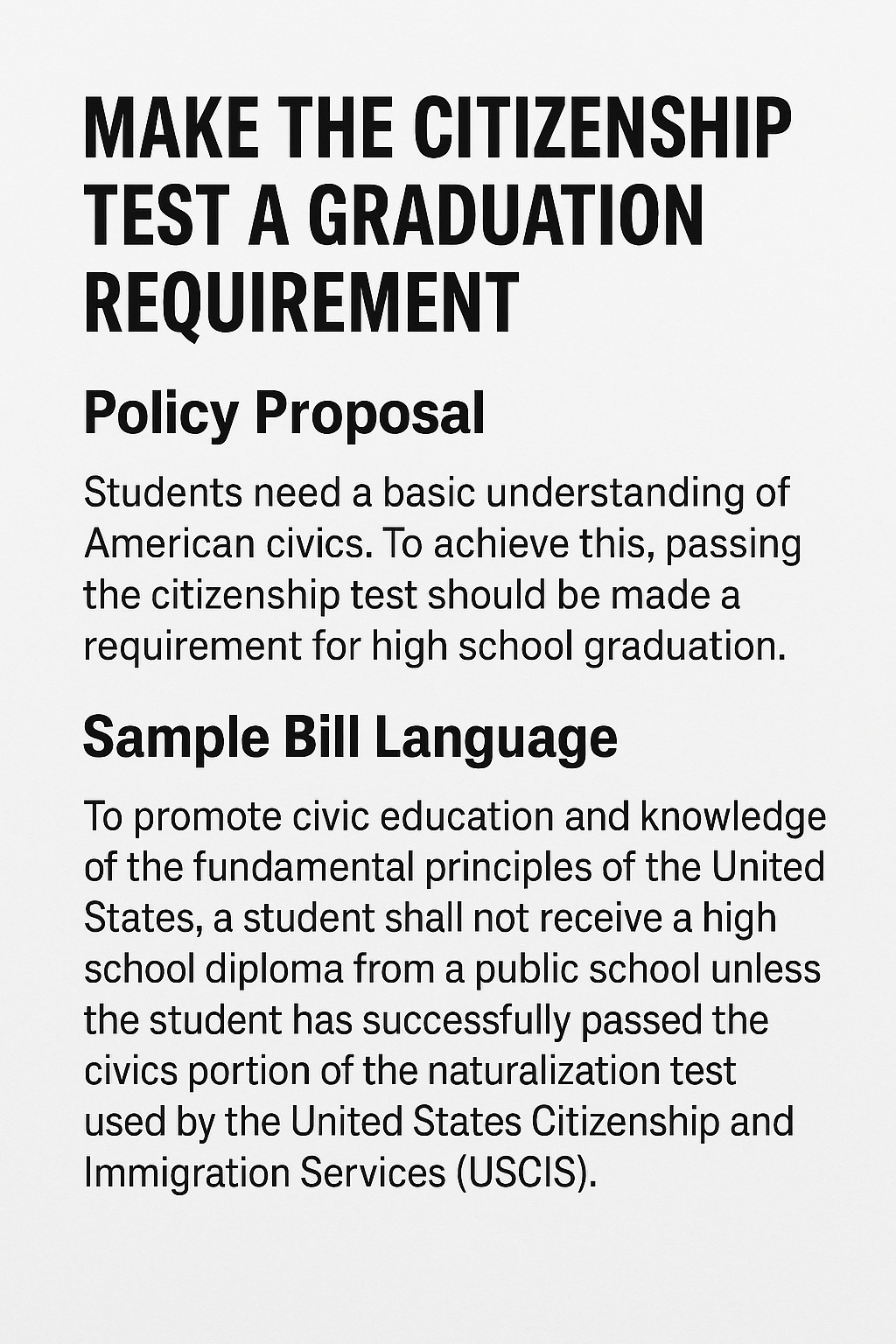
Ask a random group of adults how many senators each state has, or what the First Amendment actually protects. Too many won’t know. Yet every immigrant who takes the Oath of Citizenship does. They’re required to pass a simple civics test—basic knowledge any functioning democracy needs to survive.
So here’s a radical idea that isn’t radical at all: make passing that same test a high‑school graduation requirement.
The Core Proposal
Call it the Common Ground Civics Act. The name says it all. This isn’t Left or Right—it’s literacy in the one subject that lets everything else exist.
The plan is simple: every state adopts a short, standardized exam based on the U.S. naturalization test. Twenty questions. Multiple choice. Pass it, and you graduate. Fail it, you study until you can.
I took that same test cold—no prep, no review, just memory and instinct—and scored 19½ out of 20. That isn’t a brag; it’s proof the test is basic. If a brain fueled by caffeine and sarcasm can ace it, a senior in high school can, too.
Pull‑quote: Not punishment. Participation.
Students already spend twelve years in taxpayer‑funded schools. Minimum viable citizenship isn’t an ask; it’s the deal.
Why This Works
Equitable. Everyone—native‑born or immigrant—meets the same baseline.
Practical. The test already exists and costs almost nothing to administer.
Patriotic without the flag‑waving. Knowing your rights isn’t propaganda; it’s insurance against tyranny.
Bipartisan by design. The Constitution belongs to everyone—even the people who haven’t read it yet.
How to Move It in Your State
This starts where graduation rules live: statehouses and school boards. Governors can pitch it as a unifying initiative—“Every graduate ready to be a citizen.”
Want to help? Share this post and email the model bill below to your state representative, senator, or school board. Use this one‑line ask:
“Why shouldn’t our kids know what new citizens already have to learn?”
If they can’t answer that, they’ve told you everything you need to know.
FAQs (Short and Useful)
Isn’t this exclusionary? No. It’s equalizing. The standard is the same for everyone.
What about students who struggle? They can retake the test without penalty. The goal is mastery, not gatekeeping.
Partisan? Not unless counting to 100 senators became a party plank.
Local relevance? States can add a few questions on their own constitution and history. Texans learn Texas. Floridians learn Florida.
Closing Thought
The Founders didn’t expect uniform agreement; they expected informed disagreement. Civic literacy is the shared language of law, liberty, and limits. The Common Ground Civics Act won’t fix everything, but it reminds the next generation that freedom isn’t inherited by osmosis. You have to know it to keep it.
Appendix: Model Legislation (Copy‑Paste Ready)
The Common Ground Civics Act (CGCA)
Section 1. Short Title
This Act shall be known as the Common Ground Civics Act.
Section 2. Purpose
To ensure every public‑high‑school graduate possesses a working understanding of the principles, rights, and structures of the United States Constitution and this state’s constitution.
Section 3. Definitions
(a) “Civics Test” means a standardized assessment derived from the current U.S. naturalization test administered by U.S. Citizenship and Immigration Services (USCIS).
(b) “Passing score” means at least sixty percent (60%) correct responses.
(c) “Department” means the state Department of Education.
Section 4. Graduation Requirement
(a) Beginning with the graduating class of [Year + 3], all students in public high schools shall pass the Civics Test as a condition of receiving a diploma.
(b) The test shall consist of not fewer than twenty (20) questions randomly drawn from the USCIS bank.
(c) Students may retake the test without penalty until a passing score is achieved.
(d) Reasonable accommodations shall be provided for students with documented disabilities or limited English proficiency.
Section 5. Administration
(a) The Department shall design and distribute a uniform version of the Civics Test to all public schools.
(b) The Department may collaborate with accredited civic‑education organizations for curriculum support and teacher training.
(c) Schools shall report annual aggregate pass rates to the Department; the Department shall publish statewide results on a public website.
Section 6. Optional Local Content
Districts may add up to ten (10) questions on state or local government, history, or constitutional provisions.
Section 7. Recognition
(a) Students achieving a perfect score shall receive a notation of Civic Distinction on their diploma and transcript.
(b) The Department shall publicly recognize schools demonstrating exceptional civic‑literacy outcomes.
Section 8. Funding
Implementation may be supported through existing social‑studies and civic‑education budgets; federal matching funds may be sought where available.
Section 9. Severability
If any provision of this Act is held invalid, remaining provisions remain in force.
Section 10. Effective Date
This Act takes effect July 1, [Year].
Share + Act
Email this article to your state rep and school board.
Post the line: “Make the citizenship test a graduation requirement—copy the model bill here.”
Keep it polite, and keep it moving. Change spreads one district at a time.
Makes sense to me but so does fully funding the police